Most comparisons of 440 Hz and 432 Hz music online quickly leave the practical and head into the metaphysical. This piece stays with the practical. Here is what the two tunings actually are, what changes when you switch between them, and how to hear the difference for yourself under fair conditions.
The two reference pitches
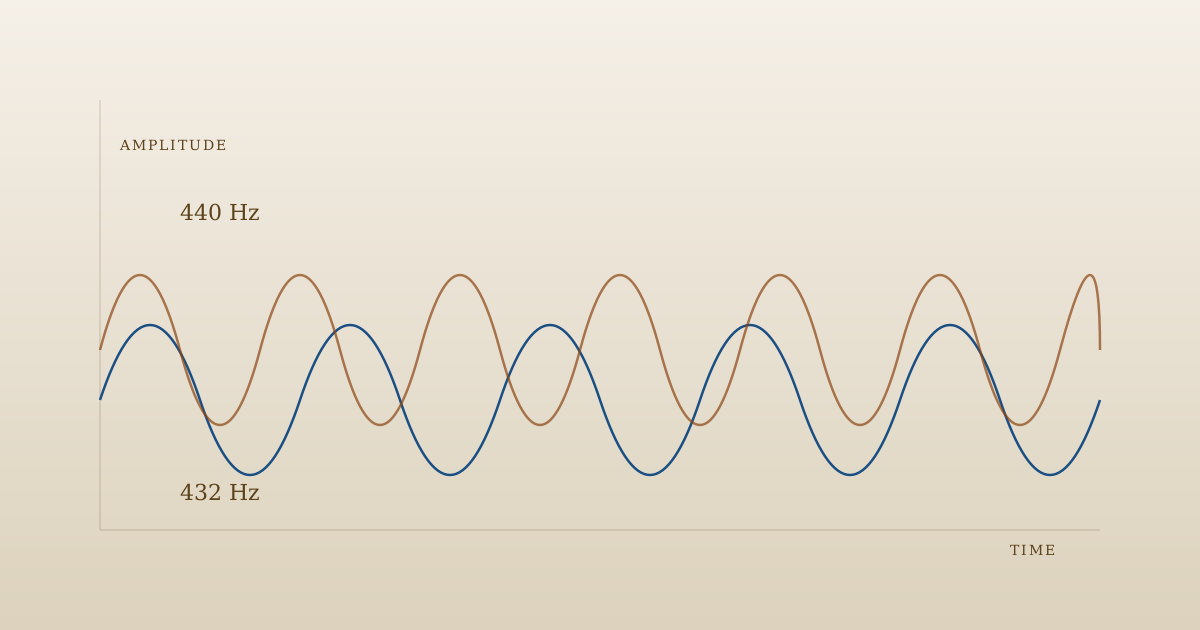
Music is tuned around a reference note — traditionally the A above middle C. In modern music production, that A vibrates at 440 Hz. This is the international standard, formalized as ISO 16:1975, and it is what virtually every orchestra, recording studio, and streaming platform uses.
432 Hz is an alternative reference. It sets that same A at 432 vibrations per second instead of 440. Every other note in the piece shifts proportionally. The result is music that is about 32 cents lower — roughly a third of a semitone. That is a small, audible shift, not a dramatic change.
What actually changes
When the same piece of music is shifted from 440 to 432, three things happen:
- Every pitch drops slightly. The music sounds a touch lower. Many listeners describe it as warmer, softer, or more relaxed.
- The relationship between notes stays the same. Melodies, harmonies, and rhythms are unaffected. It is not a different song, just the same song at a slightly different pitch.
- The recording’s character can feel subtly different. Bass notes sit slightly lower, high frequencies are slightly less piercing, and the overall tonal balance shifts.
Whether you find the shift pleasant, neutral, or imperceptible depends on your ears and the music.
What does not change
It is worth being direct about what the shift does not do. No reputable scientific body — including the NIH’s National Center for Complementary and Integrative Health — has endorsed claims that 432 Hz produces specific healing, emotional, or physiological effects. [VERIFY: confirm NCCIH position on frequency-based claims.]
The honest framing is that 432 Hz is a tuning preference, not a therapy. That is a much smaller claim than the marketing often makes, and it is the accurate one.
How to run a fair comparison
If you want to decide for yourself, here is the fair way to do it:
- Pick music you know well. Familiarity gives you a reference to compare against.
- Use a retuning tool to shift that specific song to 432 Hz. This isolates the tuning from every other variable.
- Match playback conditions. Same headphones, same volume, same room, same time of day.
- Listen to both versions. Flip between them. Notice what you notice without forcing a conclusion.
- Repeat across sessions. One afternoon is not enough for most people to form a settled opinion.
You are looking for a felt preference, not a dramatic revelation. Most listeners land somewhere in “I mildly prefer one” or “they feel about the same.” Either answer is valid.
Where to go from here
If you end up preferring retuned music, you can build a listening practice around it. Some people retune favorite albums and keep them as a dedicated evening library. Others just enjoy trying different versions of familiar tracks when they feel like it. There is no correct way.
If you find the difference subtle or unimportant, you have learned something useful too: the standard tuning you have been listening to your whole life serves you just fine.
A browser-based retuning tool is the simplest way to run the comparison. You can pull up a song you already love, flip between tunings, and decide on your own terms.
YouTube Retuning Extension
We reference it when the article context is less about ownership and more about comparing recognizable songs already living online.
A browser-based retuning tool lets you compare the same song at both tunings in one click — the fairest way to decide for yourself.Common reader questions
Can I really hear a difference between 440 and 432 Hz?
Most careful listeners can detect a shift of about a third of a semitone, which is the difference between the two. Whether you find that shift meaningful or pleasant is a personal reaction, not a universal one.
Is 432 Hz the "natural" tuning?
No. Historical tuning standards varied widely across regions and eras, and there is no single documented "natural" pitch. The 440 Hz standard was established for international compatibility in modern music production.
Should I retune all my music?
That is entirely up to you. If you enjoy the sound of retuned music, go ahead. If the difference feels subtle, there is no reason to change anything.