
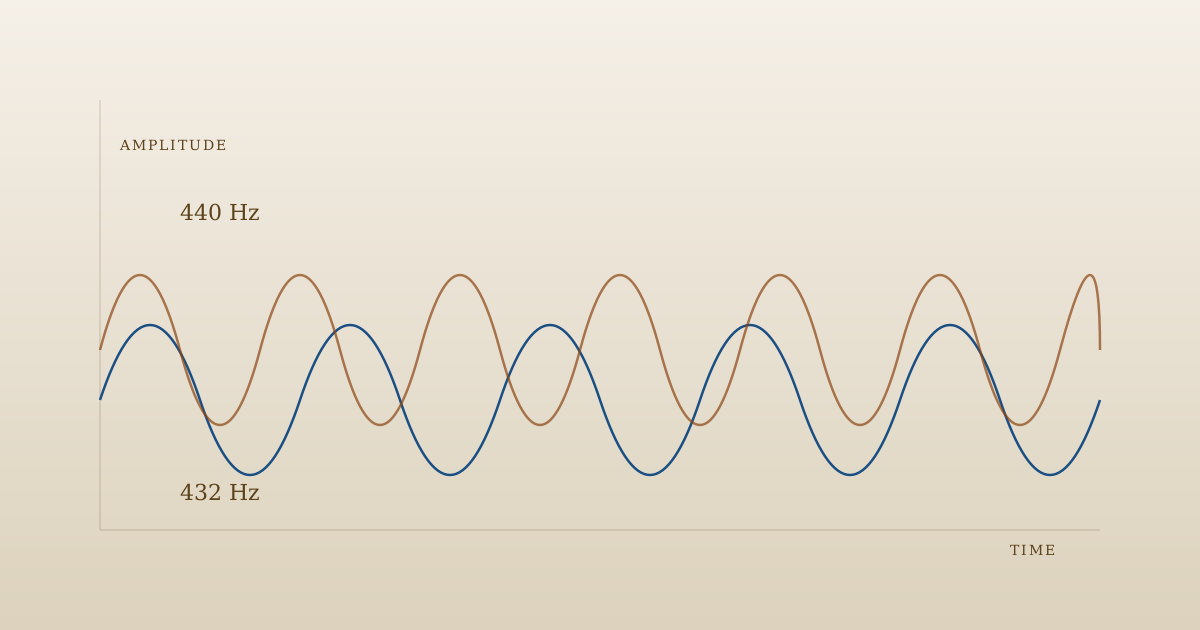
If you have spent any time browsing wellness videos or meditation playlists, you have probably come across music advertised as “tuned to 432 Hz.” The label is everywhere — on YouTube channels, streaming playlists, and relaxation apps. For newcomers, the obvious question is: what does that actually mean, and is there anything to it?
This is a beginner-friendly overview. It is not medical advice, and it does not claim that any frequency can cure or treat any condition. It is simply an honest introduction.
What 432 Hz music actually is
Music is tuned around a reference pitch. For most of the last century, that reference has been 440 Hz — the note A above middle C vibrates at 440 times per second. This standard is codified by the International Organization for Standardization (ISO 16:1975) and is what most orchestras, recording studios, and instrument makers use today.
432 Hz is an alternative reference pitch. When music is “tuned to 432 Hz,” the same A note vibrates at 432 times per second instead of 440. Every other note in the piece shifts proportionally. The result is music that is slightly lower in pitch — about a third of a semitone — than the standard version.
That is the full technical story. No mystical mechanism, no hidden physics. A small pitch shift, applied consistently across the music.
Why people try it
Listeners try 432 Hz for a few reasons:
- Personal preference. Some people simply find lower-pitched music more relaxing. Since 432 Hz tuning lowers every note slightly, the music can feel warmer or softer to certain ears.
- Curiosity. Online communities have built up around the practice, and many listeners want to hear for themselves what the fuss is about.
- Meditation routines. People who use music as part of meditation or wind-down routines sometimes find that a single consistent tuning helps anchor their practice.
Whether you notice a meaningful difference is personal. Most listeners need to compare the same song at both tunings, under identical playback conditions, before they can tell what they actually prefer.
What to look for when you explore it
A few practical tips if you are starting out:
- Use familiar music. Comparing a song you know well gives you a real reference. Comparing two unrelated tracks tells you nothing about tuning.
- Keep playback consistent. Same headphones, same volume, same room. Otherwise you may be noticing the environment, not the tuning.
- Take your time. A single back-and-forth comparison is not enough for most people. Give yourself a few sessions across different days.
- Don’t chase outcomes. Treat it as a listening experiment, not a treatment. Notice what you notice, without expecting anything dramatic.
A note on claims
Some online sources attach specific medical or emotional effects to 432 Hz music — claims about DNA repair, chakra alignment, or specific healing outcomes. These claims are not supported by peer-reviewed scientific research, and reputable institutions such as the NIH’s National Center for Complementary and Integrative Health do not endorse them. [VERIFY: confirm specific NCCIH guidance on frequency therapies.]
The honest framing is that 432 Hz is a tuning choice, not a therapy. Many listeners enjoy it. Some find it becomes part of a calming routine. Those are meaningful outcomes in their own right, and they do not require any larger claim to be valid.
The easiest way to try it
The most reliable way to explore 432 Hz music is with a retuning tool — software that takes music you already know and shifts it to 432 Hz. That way you are comparing the same performance, the same mastering, the same recording — just a different reference pitch. You can listen to your favorite album or a track you have heard a hundred times and notice, for yourself, whether the small shift feels different.
If you do try it, go in with curiosity rather than expectation. Sound, like taste in food or books, is personal. The point is to find what you enjoy.
RetunerPro
It appears in stories where local files and repeat listening matter more than trusting platform labels.
A retuning tool lets you try the same song at both tunings with one click, so you can decide for yourself.Common reader questions
What is 432 Hz music?
432 Hz music is music tuned so that the A above middle C sounds at 432 Hertz, rather than the modern standard of 440 Hz. It is a personal preference in tuning, not a medical treatment.
Is 432 Hz better than 440 Hz?
There is no controlled scientific evidence that one is universally "better." Some listeners find retuned music feels warmer or more relaxed. Others do not notice a meaningful difference. It is a matter of personal listening preference.
How do I try 432 Hz music?
The simplest way is to use a retuning tool that shifts a song you already know. That way you can compare the same music at both tunings under identical conditions and notice what feels different to you.