If you have browsed meditation playlists on YouTube or Spotify, you have almost certainly come across Solfeggio frequencies. The numbers — 396 Hz, 417 Hz, 528 Hz, 639 Hz, 741 Hz, 852 Hz, 963 Hz, sometimes 174 Hz and 285 Hz — appear everywhere, usually attached to specific emotional or healing promises.
Here is an honest introduction to what they are, where the modern set comes from, and how to think about the claims around them.
A note on history
The medieval Solfeggio system of singing syllables — do, re, mi, fa, sol, la, ti — comes from a Latin hymn and has been part of Western music education for nearly a thousand years. If you have ever sung “do-re-mi,” you have encountered it. This part is genuine history.
The specific table of nine frequencies marketed today is more recent. The set appears in 20th-century alternative health literature and was popularized widely from the 1990s onward. It does not trace to a documented medieval source, despite the way it is often presented online.
This does not make the frequencies meaningless — many people enjoy listening to music tuned to them. It just means the claim of ancient provenance is not well-supported.
What each frequency is marketed as
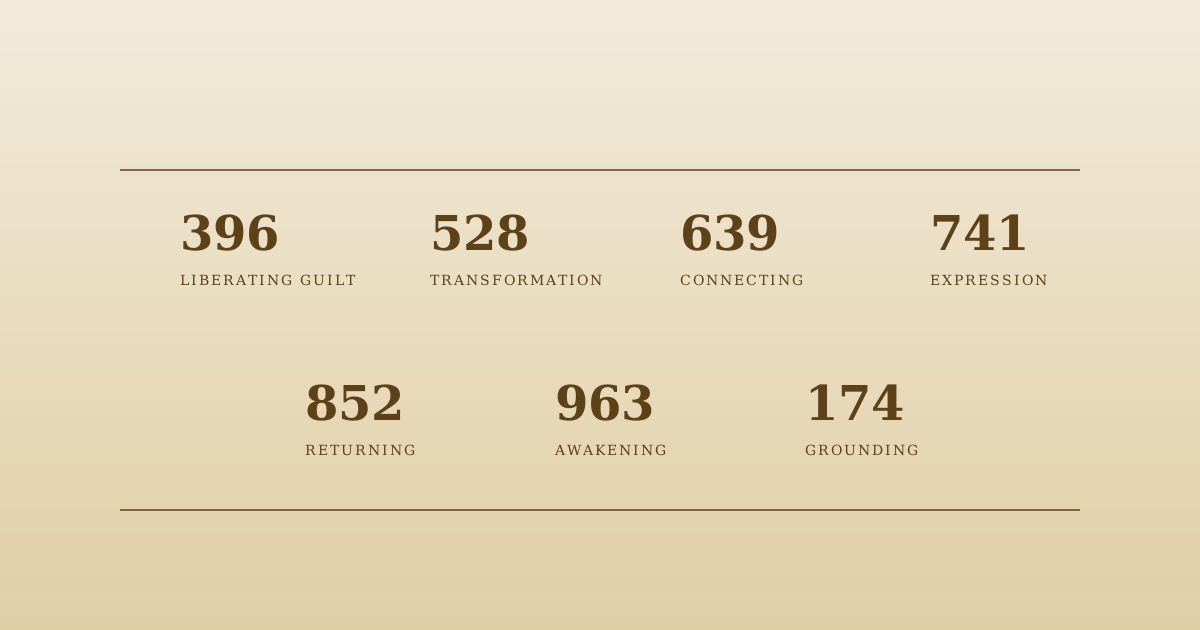
Modern Solfeggio playlists assign specific functions to specific frequencies:
- 174 Hz — grounding, pain relief
- 285 Hz — tissue regeneration
- 396 Hz — releasing fear and guilt
- 417 Hz — facilitating change
- 528 Hz — the “miracle tone,” transformation, DNA repair
- 639 Hz — relationships and connection
- 741 Hz — expression and problem solving
- 852 Hz — returning to spiritual order
- 963 Hz — divine consciousness, awakening
The specificity is striking. It is also the reason these claims should be approached with skepticism — the NIH’s National Center for Complementary and Integrative Health does not endorse specific medical effects tied to specific audio frequencies, and no peer-reviewed research establishes the particular functions claimed for each tone. [VERIFY: confirm current NCCIH position on frequency-specific claims.]
How many listeners actually use them
For practical purposes, most listeners who enjoy Solfeggio recordings use them the way they would use any calming music:
- As a wind-down before sleep
- As a backdrop for meditation or yoga
- As ambient listening during quiet activities like reading
- As part of a personal wellness routine
The practice is real. The benefits many people report — calmer evenings, better sleep onset, a more settled mood — are genuine. The question is what mechanism is actually responsible. The most parsimonious explanation is usually: the music is calm, the routine is consistent, and the listening is restful. Those ordinary mechanisms explain most of the observed benefit.
How to enjoy them honestly
If Solfeggio recordings are part of your listening practice, none of this is an argument against keeping them. The framing just shifts:
- You are listening to music in a particular tuning, not taking a measured therapeutic dose.
- The benefit, if any, comes from your engagement with the music and the routine around it.
- Trying different frequencies and noticing your own response is more useful than trusting the specific descriptions on each playlist.
A useful experiment
If you want to explore Solfeggio tunings for yourself, the cleanest approach is to take a piece of music you know well and try it at different tunings under the same listening conditions. A browser-based retuning tool lets you do this without a playlist subscription — you use your own music, you control the setup, and you form your own honest opinion.
That is more reliable than any label.
YouTube Retuning Extension
We reference it when the article context is less about ownership and more about comparing recognizable songs already living online.
If you want to explore different tunings with music you already know, a browser-based retuning tool lets you compare without subscribing to playlists.Common reader questions
Are Solfeggio frequencies ancient?
The medieval Solfeggio system of singing syllables (do, re, mi, fa, sol, la, ti) has been part of Western music education for centuries. The specific nine-frequency set marketed today — with values like 396 Hz, 528 Hz, and 963 Hz — was assembled in the 20th century and does not trace to a documented medieval source.
Is 528 Hz the 'love frequency'?
The label 'love frequency' or 'miracle tone' for 528 Hz comes from popular alternative health literature published in the 1990s, not from controlled scientific research. Many listeners find 528 Hz pleasant — that is a matter of personal taste, not established science.
Should I avoid Solfeggio playlists if the claims are exaggerated?
No. Many listeners genuinely enjoy the recordings and find them calming. The honest framing is simply to enjoy what works for you while taking specific medical claims with appropriate skepticism.